Skip to Content

Nipper solutions trial

Start a network exposure assessment trial

Validate whether your network is configured as intended, reveal hidden exposure and produce defensible evidence for security, operations and audit teams.

Choose the trial that matches the outcome you need

Every network has hidden exposure. The challenge is proving where it exists, what it could impact and which fixes will reduce risk fastest. Start with the outcome you need – stronger segmentation, fewer misconfigurations, prioritized remediation or audit-ready evidence – and we'll help scope the right assessment of your environment using Titania's Nipper solutions.

Start a trial to:

  • Reveal hidden network exposure created by device configuration
  • Validate segmentation and least-privilege access
  • Find misconfigurations, hardening gaps and ineffective rules
  • Prioritize remediation by exploitability, impact and audit relevance
  • Produce defensible evidence for compliance, regulators and the board

Start my assessment

Please fill out the fields below

Trusted by elite security organisations

What trial should I start?

What trial should I start?

Start with the outcome you need to prove. Some teams need to harden individual firewalls, routers or switches. Others need to validate segmentation, investigate unintended access paths or assess exposure across a complex estate. The trial is scoped around your objective, not a product decision you have to make upfront.

During scoping, Titania will confirm the assessment approach that best fits your use case, network environment and evidence requirements.

How does the trial work?

Titania's Nipper solutions work from extracted or minimally collected network device configurations. Nipper technology builds a repeatable view of how controls, rules, routes and device relationships behave, then identifies the risks those configurations create or fail to contain.

Nipper technology ranks findings so teams can focus on the fixes that reduce the most risk first. Because the analysis is deterministic and repeatable, teams can retest after remediation and preserve evidence for auditors, regulators, executives and the board.

Why does configuration assessment matter now?

Routers, switches and firewalls enforce the controls that decide who can access what, how an incident is contained and whether critical systems stay protected. Those controls drift, conflict and become ineffective as networks change – and AI is now compressing the time between a weakness appearing and an attacker reaching it from months to days, hours or minutes.

That makes hidden exposure a continuity question as well as a security one. When trust boundaries fail, the cost is measured in days of lost operation – production stopped, order books frozen and disruption cascading through suppliers, customers and critical services – rather than in the number of findings closed.

Segmentation, least-privilege access and validated trust boundaries have become board-level continuity controls.

Periodic manual reviews cannot keep pace with configuration change, and active scanning is not always permitted in regulated, restricted or air-gapped environments. This is the shift from reactive threat management to preemptive exposure assessment (PEA): rather than inferring risk from external signals, Nipper technology validates the configurations themselves, giving teams repeatable evidence that is fast to generate, safe to run and suitable for audit, remediation and board-level reporting.

Who is the trial for?

The trial is built for regulated, mission-critical and complex network environments where teams need proof that controls are configured and operating as intended:

Trial network exposure assessment

Measure exposure across the estate and surface the control gaps that configuration creates. During your trial, Nipper technology can:

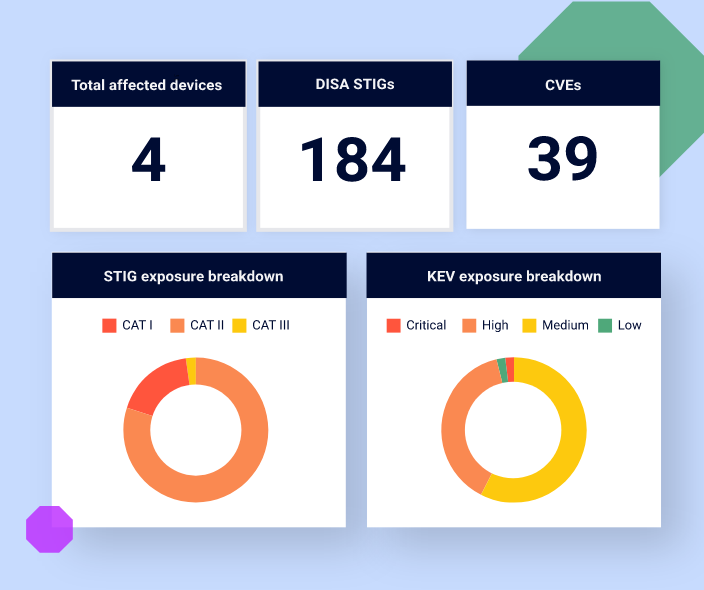
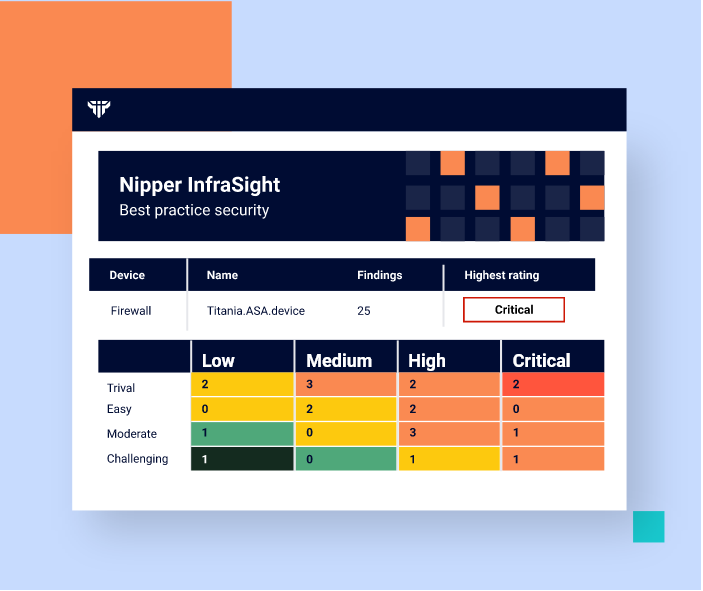
  • Produce a risk-ranked baseline of hardening gaps and weak settings
  • Understand exposure across network zones and device families
  • Prioritize findings by exploitability and impact
  • Reduce attack surface with device-specific remediation guidance
Exposure Assessment

Trial segmentation and least-privilege validation

Validate whether intended trust boundaries hold and whether least-privilege access is enforced in practice, not just documented in policy. Nipper technology helps identify:

  • Segmentation boundaries that fail in practice
  • Overly permissive rules and least-privilege exceptions
  • Conditions that could enable lateral movement
  • Enforcement gaps between policy intent and device configuration
Segmentation Least Privilege

Trial unintended access path analysis

See how individual misconfigurations combine into routes toward critical assets – including paths that are unseen in live traffic and invisible to tools that assess devices in isolation. Nipper technology maps:

  • Reachability between zones and devices
  • Unintended access paths created by rule and route interactions
  • Security zones and trust relationships
  • Exposure of critical assets at the end of those paths
Unintended Access Path

Trial compliance evidence automation

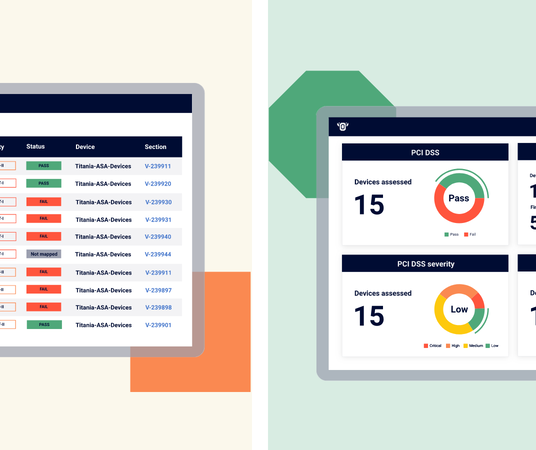
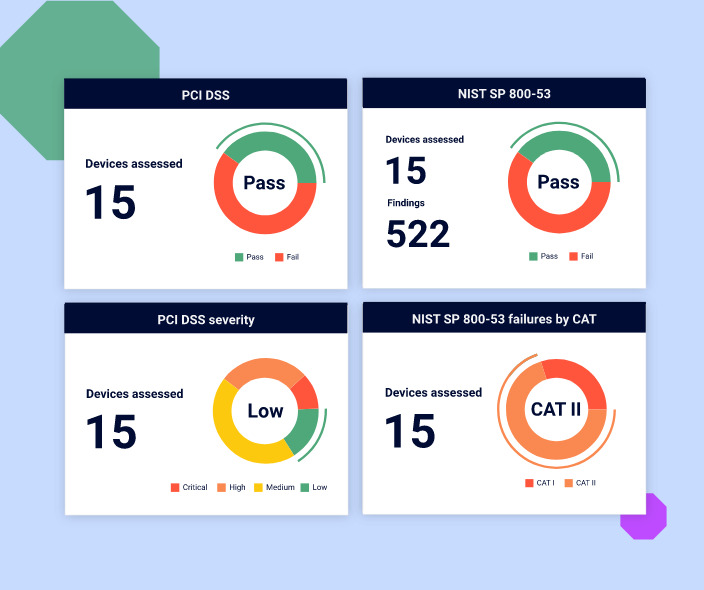
Nipper technology generates repeatable, audit-ready evidence from exported device configurations, mapped to the frameworks and standards you report against. This supports organizations working toward:

  • NIST
  • PCI DSS
  • CIS Benchmarks
  • NCSC CAF
  • CMMC
  • STIGs
Compliance Automation

How the assessment works alongside vulnerability and exposure platforms

Titania's Nipper solutions are not a replacement for outside-in scanning. They are the configuration evidence layer beneath it – validating the network conditions broad platforms infer from but leave unproven, then feeding defensible findings back into the tools and workflows you already run.

Scanners, NDR and broad exposure platforms Nipper solutions – configuration-led assessment
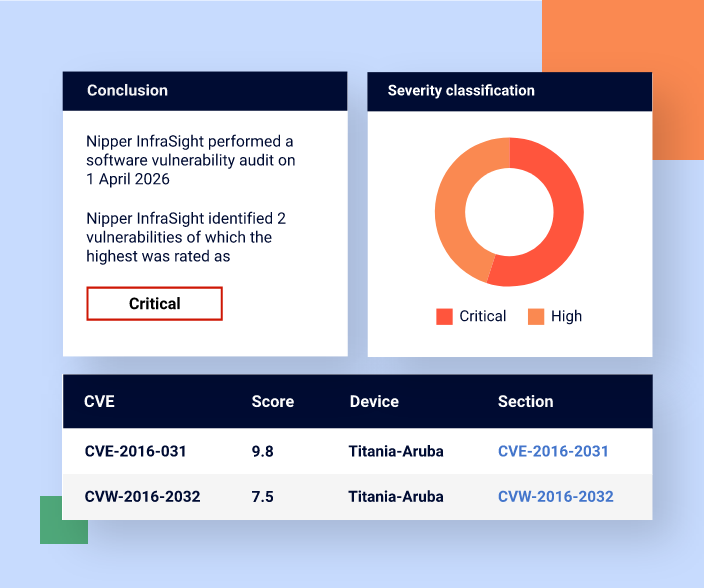
Assess software vulnerabilities and external signals Validates the network configurations that enforce access and containment
Require connectivity, credentials or agents on live systems Works from extracted or minimally collected configurations – no agents, no cloud, no live scanning
Infer whether controls are working Proves whether controls are working, with preserved evidence
Often generate high finding volumes with limited context Ranks findings by exploitability and impact, with device-specific remediation
Constrained in restricted and air-gapped environments Designed for regulated, high-consequence and air-gapped environments
Limited visibility into segmentation enforcement Validates segmentation boundaries and least-privilege access

What happens after I register?

Trusted where failure is not an option

700+ organizations trust Nipper
100+ critical infrastructure providers
169 government and defense organizations
30+ US federal agencies
180+ device types
20+ vendors
43 Operating in 43 countries across 6 continents
80% reduction in audit prep time

Frequently asked questions