Skip to Content

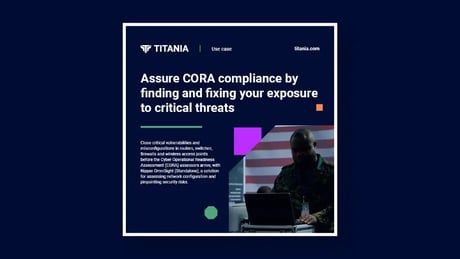
Be ready for a Cyber Operational Readiness Assessment (CORA)

Help your team prepare routers, switches, and firewalls for CORA. Turn DISA STIG checks into prioritized fixes and inspection-ready reporting. Your job: prove control effectiveness with configuration-backed evidence CORA reviewers can trust.

cora-banner

Get CORA-ready without last-minute configuration scrambles 

CORA shifted DoD cybersecurity from checklist compliance to operational readiness. For network security teams, that means your routing, segmentation, and firewall policy must hold up under threat-informed scrutiny, using evidence grounded in device configurations. 

The Integrated tier of Nipper OmniSight automates configuration ingestion using read-only CMDB or configuration storage synchronization and routes prioritized findings into SIEM workflows.

If your network changes frequently, Nipper OmniSight (Continuous) supports CTEM with continuous monitoring and real-time drift detection, so you can validate readiness between CORA inspection windows. 

You get remediation guidance mapped to DISA STIG expectations. Reporting is built to answer inspector questions: what was assessed, what failed, what changed, and what was fixed. 

100+ Elite cyber teams trust us
24x7 Monitoring
180+ Devices supported

What makes CORA readiness hard for network security teams

Turn CORA preparation into repeatable readiness work 

CORA rewards teams that can show control effectiveness on high-priority cyber terrain, using evidence grounded in configuration state. Nipper OmniSight helps you turn configuration data into prioritized action and inspection-ready reporting, while fitting into the systems your teams already use. 
automate-evidence-collection

Automate evidence collection

The Integrated tier of Nipper OmniSight imports configurations through read-only CMDB or configuration storage sync. It then runs configuration-focused checks using Titania’s virtual device modelling. You get consistent, repeatable results across routers, switches, and firewalls. You do not need scan coverage to confirm the network configuration.

Route findings to action

Use the Integrated tier of Nipper OmniSight to send prioritized, configuration-based findings into SIEM workflows. Use them for triage and tracking. CMDB context (owner, criticality, location) helps recommenders explain what to fix first. It also helps practitioners assign and verify fixes, without rewriting evidence for each audience. 

route-findings-to-action
validate-change-with-ctem

Validate change with CTEM

Nipper OmniSight (Continuous) supports continuous threat exposure management (CTEM) by monitoring configuration change and re-validating exposure conditions as environments evolve. Network security teams get real-time visibility to spot drift as it happens. They can see what changed and cut the time misconfigs can be exploited. 

Outcomes you can prove

Network security teams use Nipper OmniSight to build audit-ready evidence for the Cyber Operational Readiness Assessment (CORA). It helps reduce exposure caused by misconfigurations. It also shows measurable improvements in operational readiness across the network control plane. Nipper is trusted by more than 100 elite cybersecurity teams for configuration accuracy in high-assurance environments. 

Nipper OmniSight tiers for CORA

Use the Integrated tier of Nipper OmniSight to automate CORA evidence workflows across CMDB and SIEM. Use Nipper OmniSight (Continuous) when you need CTEM to monitor change and validate readiness between inspections. 

Prepare for your next CORA inspection 

Share your device scope, constraints, and CORA objectives. We will show how network security teams use Nipper OmniSight Integrated helps automate evidence workflows across CMDB and SIEM. We will also show how Nipper OmniSight Continuous supports CTEM to validate configuration changes between inspections. 

Frequently asked questions

These questions explain how network security teams prepare for the Cyber Operational Readiness Assessment (CORA). They also cover what evidence is needed and show how to build repeatable cyber readiness workflows. These workflows do not rely on disruptive scanning.