Use configuration files, not live access
Analyze exported configurations offline – no credentialed access and no changes to live systems – supporting air-gapped and regulated environments.
See and reduce network exposure created by misconfigurations, weak segmentation, and risky change. Nipper OmniSight helps you prioritize what to fix, prove enforcement, and recover faster using exported configurations backed by deterministic, defensible evidence and repeatable findings. No credentialed access required and no need to touch live systems.

Network security teams are expected to prove segmentation, keep configurations hardened, and make change safe across hundreds or thousands of devices. But drift, incomplete inventories, and policy-only tools can hide exploitable paths.
Nipper OmniSight provides evidence-based exposure management using exported device configurations. It helps you prioritize remediation and show measurable risk reduction. It is ideal for use in regulated and high-consequence environments.
Surface configuration-driven exposure and unintended access paths that scan-only approaches can miss.
Validate Zero Trust segmentation and least privilege access (LPA) enforcement across devices and zones.
Compare baselines to spot risky change and support rollback to a known-good state.
Nipper OmniSight turns exported device configurations into actionable exposure insight. It helps your team focus on what is reachable, exploitable, and fixable without disrupting production networks or relying on credentialed access. It enables you to defend decisions with deterministic, repeatable results in high-assurance environments.

Use one platform to reduce exposure and validate segmentation. Automate evidence for security and compliance across vendors, sites, and teams.
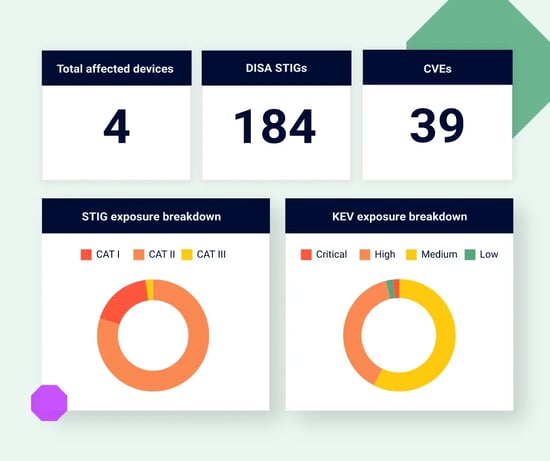
Identify and prioritize network exposures rooted in device configuration: misconfigurations, weak hardening, and gaps in enforcement. Focus on what is reachable and likely to matter to an attacker, then drive remediation with clear evidence. This helps network security teams reduce attack surface and show progress without creating scanning noise.


Validate whether routers, switches, firewalls, and gateways enforce your intended zones and trust boundaries. Find where permissive rules, routing, or ACL behavior undermines least privilege access (LPA). This gives security teams defensible assurance that critical segments are protected and helps reduce lateral movement risk.
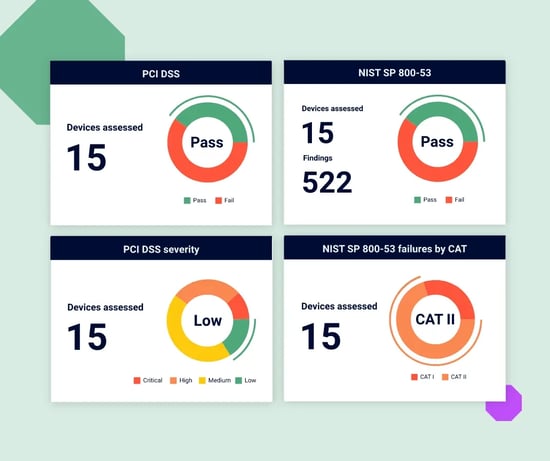
Automate configuration evidence for internal policies and external frameworks using consistent, repeatable assessment logic. Replace spreadsheet-driven sampling with network-wide validation you can rerun and compare over time. This streamlines audit preparation, supports compliance automation, helps prove control effectiveness, and reduces time spent chasing evidence across teams.


Maintain baselines and compare configurations across assessment cycles to find drift, weak settings, and unintended access. Use repeatable assessments to validate that changes don’t expand access, break segmentation, or weaken hardening. This helps network security teams reduce change risk, support faster recovery, and produce evidence that controls remain enforced over time.
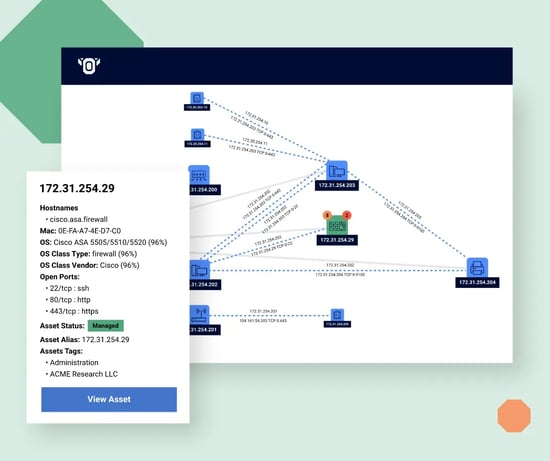
See how misconfigurations and segmentation failures connect into attacker routes toward critical assets. Use clear network maps to validate reachability, prioritize fixes with the biggest impact, and reduce lateral movement opportunities. This helps security leaders and practitioners align remediation to business services instead of treating findings as isolated issues.

Analyze exported configurations offline – no credentialed access and no changes to live systems – supporting air-gapped and regulated environments.
Detect control-plane exposures in exported device configurations: misconfigurations, weak controls, and segmentation gaps that create reachable attack paths.
Rank exposures by exploitability and business relevance so teams address what reduces risk fastest.
Add ownership and environment context, then route prioritized findings into the workflows your team uses to drive remediation.
You need results you can defend – without adding risk to production networks. Nipper OmniSight produces deterministic, defensible findings from configuration files, runs in air-gapped environments, and avoids credentialed access or changes to live devices.
Builds a behavior-based virtual model from configuration files to identify reachable exposure and segmentation gaps other approaches miss.
Deterministic configuration analysis delivers repeatable findings with fewer false positives, so teams can act and report with confidence.
Works from configuration files – no credentialed access and no changes to live devices – reducing operational risk in sensitive environments.
Runs offline without internet connectivity, supporting air-gapped, classified, sovereign, and highly regulated environments.
Powered by award-winning Nipper technology trusted by 1,000+ organizations and 100+ elite cybersecurity teams worldwide.
UK-engineered. Globally trusted. Named a winner at RSAC 2026 by Cyber Defense Magazine for Hot Company – Risk-Based Vulnerability Management and Most Advanced – Continuous Threat Exposure Management (CTEM). The awards recognize giving network security teams defensible visibility into configuration weaknesses that can create real attack paths and undermine segmentation enforcement.

“One of the key strengths is its ability to map configuration findings against compliance frameworks and security best practices. The reporting is structured, audit-friendly, and helps stakeholders clearly understand risk exposure. The risk-based prioritization is particularly valuable, as it allows us to focus remediation efforts on high-impact issues.”
“I find Titania Nipper's reports and outputs to be thoroughly well-defined. I also appreciate the accuracy when it comes to framework benchmarking and testing. Additionally, the initial setup is easy to install and use."
“I like Titania Nipper's features for detecting risk areas. The scans help in identifying misconfigurations that could lead to high risks, allowing them to be quickly actioned. It's useful for enterprises serious about detecting issues with their network configurations.”
“I use Titania Nipper for network device configuration review, and it helps me easily assess our network devices. I really appreciate its ability to provide recommendations and ratings for each misconfiguration found, as it helps in confidently communicating exactly what needs to be done. The ratings are also useful for understanding the criticality of issues.”
“I appreciate its ability to relieve the manual part, especially when checking CIS Benchmarks and NIST frameworks. Using it as a core tool for network tool assessment, I can simply upload our configuration, and it generates reports in seconds. Titania Nipper stands out for its cost and efficiency.”
Connect configuration-backed exposure insight to the systems your team already uses for asset context, investigations, and governance. Nipper OmniSight complements existing tooling – no rip-and-replace required.
These FAQs answer common questions from network security teams about exposure management platforms. They cover configuration-based exposure, attack path mapping, zero trust segmentation assurance, and security compliance automation.
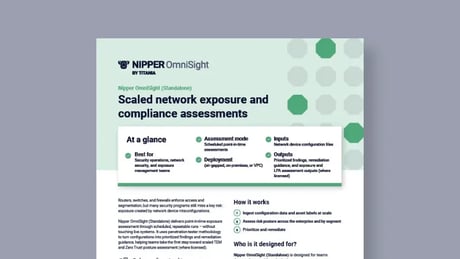
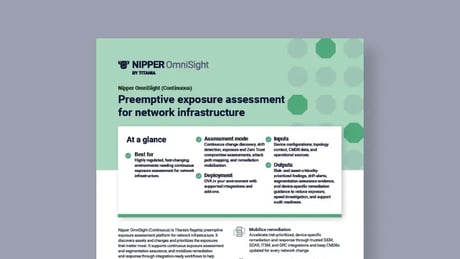
Nipper OmniSight is designed to scale from scheduled, repeatable exposure assessments to continuous threat exposure management (CTEM) for configuration change. The right choice depends on how you collect configurations today. It also depends on whether you use a CMDB or a repository and how you share findings across teams. Use our tier comparison to confirm the best match for your environment.
Many exposures are created by exported device configurations – not just missing patches. Nipper OmniSight analyzes routers, switches, firewalls, and related infrastructure to find misconfigurations, weak hardening, and segmentation gaps that can create reachable attack paths. This helps teams reduce exposure in the network control plane where attackers often move laterally.
Attack path mapping shows how multiple configuration weaknesses combine into routes toward critical assets. Instead of fixing findings in isolation, network security teams can focus on the changes that break attacker access, reduce lateral movement, and protect key services. This supports defensible prioritization based on reachability and impact.
No. The Standalone tier of Nipper OmniSight is designed to deliver value without a CMDB by assessing the configurations you provide on a scheduled cadence. If you do have a CMDB or configuration repository, the Integrated tier of Nipper OmniSight can ingest that context to improve ownership, baselines, and reporting.
An exposure management platform helps you discover and prioritize the exposures most likely to lead to compromise. For network security teams, that means validating network configuration and segmentation controls, not just scanning for CVEs. This helps remediation focus on reachable, high-impact attack surface exposures.