






























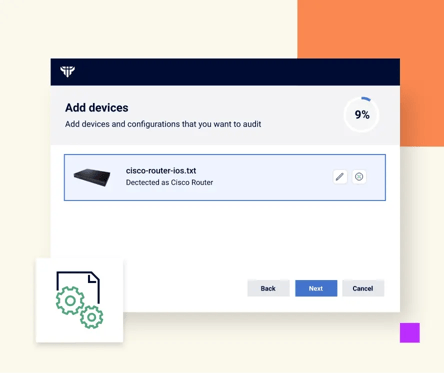
Export device configurations
Export configs from routers, switches, firewalls, and supported devices as close to assessment time as possible.
Prove what your routers, switches and firewalls enforce. Assess exported configurations to find exploitable gaps, prioritize fixes, and support audit evidence – without touching live devices.

Trusted by elite cybersecurity teams
Network security teams must reduce exposure and prove controls are effective across the routers, switches, and firewalls that enforce access and segmentation. But scanners, NDR, and policy automation don’t validate configuration logic end-to-end or show what’s truly enforceable. Nipper InfraSight assesses exported configurations to produce point-in-time evidence you can act on – so you can prioritize vulnerability remediation, verify hardening against a baseline, and generate audit-ready compliance evidence. It works in environments where credentials and active probing add risk.
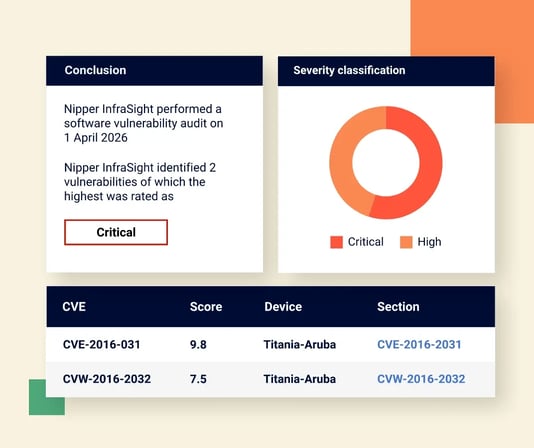
Run point-in-time, configuration-based assessments on routers, switches, and firewalls. Prioritize remediation by risk and prove vulnerability mitigation with evidence.
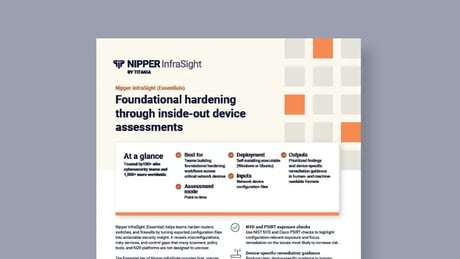
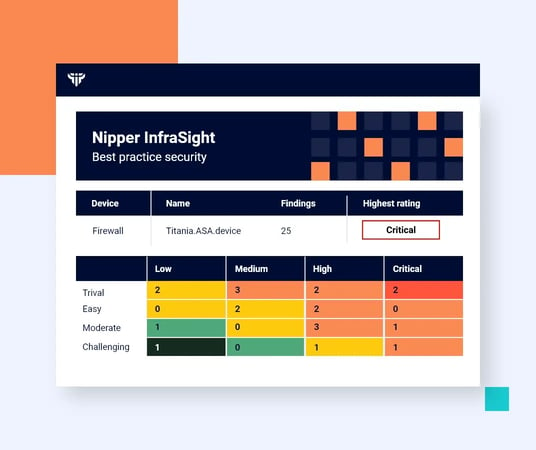
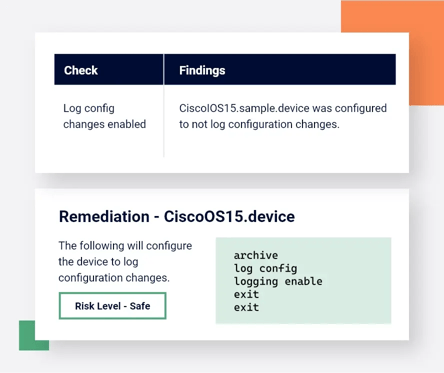
Validate device hardening against your baseline configuration using exported configs. Get prioritized findings, device-specific remediation, and evidence-ready reporting. No scanning or touching live systems required.
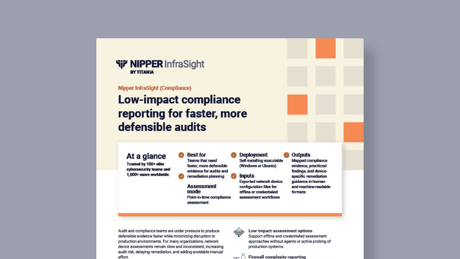
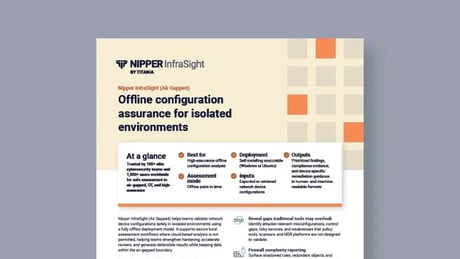
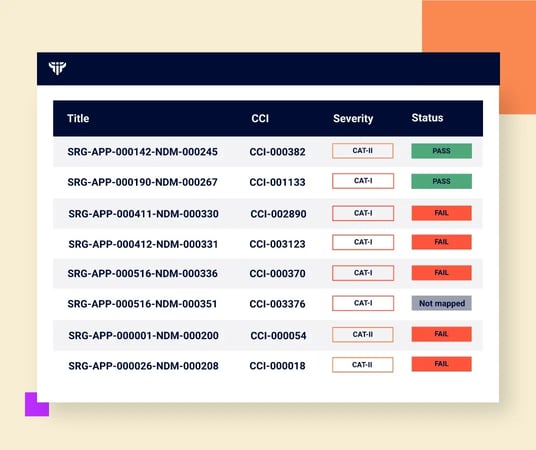
Review exported device configurations offline and create control-mapped, pass / fail evidence for audit, GRC, and security teams. Support regulated and air-gapped environments without direct device access or bandwidth impact.
Nipper InfraSight turns exported device configurations into clear, defensible insight - so you can prioritize remediation, reduce attack paths, and report progress with confidence.

Network security assessment should do more than list issues. You need to know what matters, why it matters, and what to fix first - across the devices that enforce trust and segmentation.
Assess exported configurations to identify vulnerabilities and misconfigurations in the context of how devices are configured. This cuts noise and gives practitioners evidence they can check. It also gives decision-makers clearer reports on risk cuts and audit readiness.


Validate device settings against hardening guidance and best practice security audits, including CIS Benchmarks where supported. Spot weak access controls. Find unsafe services. Identify loose rules. Catch credential risks. These issues can weaken your baseline and expand your attack surface.
Support compliance assessment with defensible, repeatable outputs. In the Compliance tier of Nipper InfraSight and the Air Gapped tier, create structured, control-aligned reports. These reports support frameworks like NIST SP 800-53, NIST SP 800-171, PCI DSS 4.0, and CMMC.

Export configs from routers, switches, firewalls, and supported devices as close to assessment time as possible.
Nipper InfraSight builds a behavior-based model from the configuration to reflect how the device will behave.
Apply best-practice audits and vendor guidance checks to identify misconfigurations, gaps, and vulnerabilities attackers exploit.
Use prioritized findings and device-specific guidance, then re-run assessments to verify fixes and produce evidence.
Broad exposure management platforms aim to cover everything, but they often lack deep configuration assurance for the devices that enforce segmentation and access. Nipper InfraSight is purpose-built for network devices, using exported configurations to deliver accurate, repeatable findings – without credentials or changes to live systems.
Focused on routers, switches, firewalls and wireless access points, with device-specific security checks.
Builds a behavior-based model from configs to identify reachable exposure and segmentation gaps.
Deterministic configuration analysis delivers repeatable findings with fewer false positives.
Works from exported configs with no credentialed access and no changes to live devices.
Use the Air Gapped tier of Nipper InfraSight for offline operation in restricted networks.
Recognized by RSAC’s Global InfoSec Awards (2026), named a G2 Grid Leader (Spring 2026), and honored by Cyber Defense Magazine and the Cybersecurity Excellence Awards.

Titania has long-term partnerships with leading switch, router, and firewall vendors. These partnerships help Nipper InfraSight assess more than 180 devices. It also provides device-specific guidance for fixes.
“One of the key strengths is its ability to map configuration findings against compliance frameworks and security best practices. The reporting is structured, audit-friendly, and helps stakeholders clearly understand risk exposure. The risk-based prioritization is particularly valuable, as it allows us to focus remediation efforts on high-impact issues.”
“I find Titania Nipper's reports and outputs to be thoroughly well-defined. I also appreciate the accuracy when it comes to framework benchmarking and testing. Additionally, the initial setup is easy to install and use."
“I like Titania Nipper's features for detecting risk areas. The scans help in identifying misconfigurations that could lead to high risks, allowing them to be quickly actioned. It's useful for enterprises serious about detecting issues with their network configurations.”
“I use Titania Nipper for network device configuration review, and it helps me easily assess our network devices. I really appreciate its ability to provide recommendations and ratings for each misconfiguration found, as it helps in confidently communicating exactly what needs to be done. The ratings are also useful for understanding the criticality of issues.”
“I appreciate its ability to relieve the manual part, especially when checking CIS Benchmarks and NIST frameworks. Using it as a core tool for network tool assessment, I can simply upload our configuration, and it generates reports in seconds. Titania Nipper stands out for its cost and efficiency.”
These FAQs explain how network security teams use Nipper InfraSight. They cover network security assessments, vulnerability management, network hardening, and compliance checks using configuration-based evidence.
A network security assessment evaluates how your network is exposed and where controls are weak. For network devices, that means validating the configurations that enforce segmentation, routing, and access. Nipper InfraSight assesses exported device configurations to identify vulnerabilities, misconfigurations, and control gaps with prioritized findings and remediation guidance.
Scans can miss weaknesses where exposure depends on rules, access paths, or device settings. Configuration analysis helps you validate what the device is configured to allow, not just what responds to a probe. Nipper InfraSight focuses on routers, switches, and firewalls. It finds misconfigurations, conflicts, and gaps that scanners and policy tools may miss.
It strengthens vulnerability management by adding configuration-based findings for network devices. This helps teams prioritize fixes based on exploit risk and exposure, not CVE lists alone. Practitioners get device-level evidence and guidance; decision-makers get clearer reporting on risk reduction and remediation progress.
Compliance assessment reporting depends on tier. The Compliance tier of Nipper InfraSight and the Air Gapped tier add structured reports supporting audit preparation with repeatable evidence. These reports align with controls and map to major frameworks. These include NIST SP 800-53, NIST SP 800-171, PCI DSS 4.0, and CMMC.
Yes. The Air Gapped tier of Nipper InfraSight is designed for offline and restricted environments where cloud analysis, credentialed scanning, or active probing are restricted or prohibited. It provides the full Nipper InfraSight capability set while keeping assessment workflows aligned to strict data-handling requirements.