Prove CMMC compliance for network devices – faster
Assess routers, switches, and firewalls against CMMC 2.0 requirements. Prioritize fixes that protect CUI and FCI. Generate assessor-ready evidence without manual configuration reviews.

CMMC readiness stalls without verifiable network configuration evidence
If you support the defense industrial base, you need to show that routing, access control, and segmentation are configured to protect controlled unclassified information (CUI) and federal contract information (FCI).
But CMMC readiness work often slows down because teams collect evidence by hand. Device standards vary by team and vendor. It is hard to keep consistent visibility across routers, switches, and firewalls.
Nipper solutions help you turn real device configurations into CMMC evidence: map settings to requirements, pinpoint what fails (and why), and produce repeatable outputs you can reuse for self-assessments and C3PAO-led audits across CMMC level 1 and CMMC level 2.
What makes CMMC readiness hard for network security teams
Scope keeps growing
When CUI boundaries are unclear, more devices become in-scope. Over-scoping increases cost; under-scoping risks a failed CMMC assessment.
Evidence takes too long
Pulling configs, screenshots, and notes manually (instead of by hand) is slow. Evidence gaps lead to assessor follow-ups and rework.
Device baselines are inconsistent
Different teams and vendors mean different standards. Small configuration differences can break CMMC compliance requirements.
Too many findings to triage
Without clear risk context, teams fix low-impact issues first. The result is slower progress toward CMMC certification.
Segmentation is hard to prove
Assessors want to see that trust boundaries are enforced as designed. Network diagrams alone don’t show policy enforcement on devices.
Changes erode readiness
Approved configurations drift over time. By the time evidence is collected, the network may no longer match your SSP.
Turn CMMC requirements into config-backed evidence

Assess against CMMC 2.0
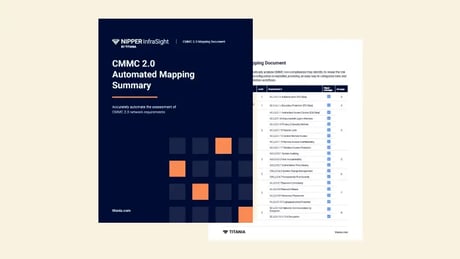
Use a pre-built mapping to check routers, switches, and firewalls for CMMC compliance. It covers CMMC Level 1 and CMMC Level 2 requirements. See the exact settings behind each pass or fail result and match technical changes to your SSP and CMMC compliance checklist.
Prioritize fixes that matter
Move from long findings lists to risk-led remediation. Nipper solutions highlight configuration weaknesses that may expand attacker access, weaken segmentation, or reduce logging. They help you focus engineering effort where it improves CMMC readiness fastest.


Produce assessor-ready outputs
Generate consistent evidence packages for internal review and external assessment. Reports include control mapping, technical context, and step-by-step remediation guidance. This supports annual self-assessments and preparation for a C3PAO-led CMMC audit where required. Re-run assessments to confirm fixes and document progress.
Outcomes you can evidence
CMMC certification depends on what you can prove. Nipper solutions help your team cut time spent on evidence collection. Focus remediation on the controls that protect CUI. And show measurable progress toward CMMC compliance.
Faster CMMC readiness decisions
Replace manual config review with repeatable outputs that show what passes, what fails, and what to do next.
Defensible audit evidence
Produce consistent, control-mapped reports that stand up to self-assessment and external CMMC evidence requests.
Risk-led remediation focus
Prioritize weaknesses that expand access paths, weaken segmentation, or undermine access control and logging.
Repeatable control validation
Re-run assessments to confirm fixes and reduce readiness drift between change windows and audit milestones.
Stronger network control assurance
Validate device hardening, routing, and segmentation intent with configuration evidence that supports least privilege and boundary enforcement.
Choose the right Nipper solution tier
Start with device-level CMMC compliance evidence. Then scale to scheduled, integrated, or continuous assurance as your network grows. Do this as your audit cadence increases.
Nipper InfraSight (Compliance)
Point-in-time device checks mapped to CMMC requirements. Includes pass or fail evidence and remediation guidance for audit preparation.
Nipper OmniSight (Standalone)
Scheduled, repeatable assessments across larger estates to track CMMC readiness over time, prioritize remediation, and report network-wide risk.
Nipper OmniSight (Continuous)
Continuous monitoring (CTEM) for networks where every configuration change must be validated. Includes change detection and alerting for exposure and compliance risk.
CMMC compliance resources
Frequently asked questions
These FAQs cover CMMC 2.0 basics and the evidence assessors often expect. They also explain how network configuration reports support CMMC compliance and readiness.
-
Any organisation in the defense industrial base that handles Federal Contract Information (FCI) or Controlled Unclassified Information (CUI) may need CMMC certification. The required level will be stated in the contract or solicitation. This requirement may also flow down to subcontractors.
-
CMMC level 1 focuses on basic safeguarding for FCI and is assessed through self-assessment. CMMC Level 2 aligns with NIST SP 800-171 requirements to protect CUI. It may require a C3PAO assessment, depending on the contract.
-
Assessors usually expect a current system security plan (SSP), a defined scope, and data flows. They also expect policies and procedures, as well as objective evidence that controls are in place. For network controls, configuration evidence, change records, and repeatable reports help reduce follow-up questions.
-
Nipper solutions analyze router, switch, and firewall configurations against mapped CMMC compliance requirements and produce control-aligned outputs. You can prioritize remediation, re-run assessments after fixes, and create consistent evidence packs for internal and external reviews.
-
No. Nipper solutions help you prepare for CMMC audits by providing configuration-based evidence and remediation guidance. Certification decisions sit with your organisation and, where required, your C3PAO assessor and the Department of Defense.